Biochar can capture CO₂ and also increase the drought resilience of crops by improving soil water retention. With warming temperatures and increasingly extreme weather, this characteristic provides a method of adapting agricultural land to a changing climate.
Physical Structure and Water Retention
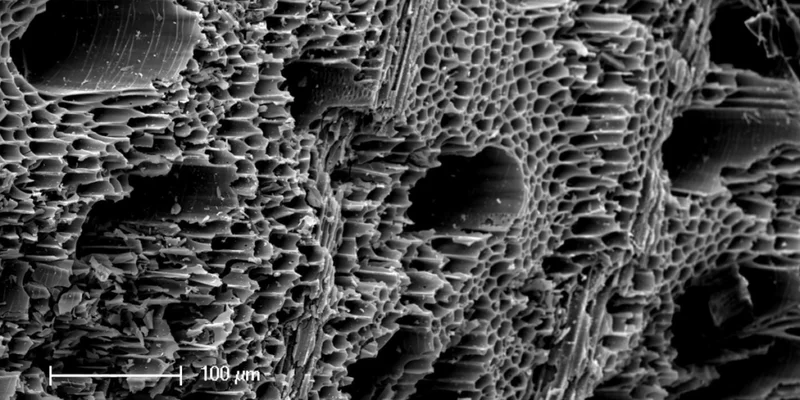
Biochar’s water retention capacity stems from its porous structure. During pyrolysis, the internal structure of plant material—the vascular system that transported water and nutrients—is preserved while volatile gases are driven off. This creates a carbon structure with an extensive internal network of pores.
Pore Structure Properties
Research published in Geoderma shows that well-produced biochar can exhibit surface areas exceeding hundreds of square meters per gram. This network of micropores and macropores creates what soil scientists call a hierarchical pore structure.
In sandy soils, these pores act as reservoirs, holding water that would otherwise drain quickly. The available water content can increase by over twenty percent compared to untreated soils in some studies. In heavy clay soils, biochar improves aeration and water infiltration by creating larger soil aggregates, reducing waterlogging and runoff after rain events on compacted ground.
However, effects vary by soil type. Field studies across Europe demonstrate that while biochar substantially improves water retention in coarse-textured or degraded soils, the effect is less pronounced in Mediterranean calcareous soils or soils already rich in organic matter.
Field Trial Results
Meta-analyses examining over a hundred field trials show that biochar typically increases crop yields by approximately ten to fifteen percent overall. Benefits increase under drought stress conditions.
Regional Performance Data
Water-stressed regions show stronger effects. In Chinese agricultural systems, researchers found that application to rice paddies and maize fields enhanced productivity and reduced irrigation requirements. Farmers reported extending intervals between watering by several days without yield reduction.
Long-term studies show compounding effects. A four-year trial in Colombia found that while maize yields showed modest improvement in the first year, by the fourth year productivity had more than doubled. This suggests biochar’s benefits increase over time as it integrates into the soil ecosystem.
Tropical regions with degraded soils show the largest improvements. Farms in Southeast Asia, sub-Saharan Africa, and parts of South America report yield increases ranging from twenty to forty percent when biochar is applied to nutrient-poor, drought-prone soils. Temperate regions with naturally fertile soils see more modest gains, though drought-buffering effects remain measurable.
Biological Interactions
Biochar’s porous structure creates habitat for soil microorganisms. Soil ecologists describe this structure as providing protected habitat where bacteria, fungi, and other organisms can survive during dry periods.
Mycorrhizal Fungi
Mycorrhizal fungi form partnerships with plant roots, extending the effective root system through microscopic fungal threads. This partnership becomes particularly important under drought stress.
Biochar enhances mycorrhizal networks through several mechanisms. The porous structure provides colonization sites for fungi. Biochar’s water-holding capacity keeps fungal networks hydrated longer during dry periods. Research indicates that biochar surfaces can concentrate nutrients, creating areas that attract and sustain beneficial microbes.
These microorganisms produce polysaccharides that bind soil particles together into stable aggregates. This further improves the soil’s ability to capture and retain rainfall.
Nutrient Retention
As soils dry, nutrients become less mobile and harder for plants to access. Biochar affects cation exchange capacity—the soil’s ability to hold positively charged nutrients like potassium, calcium, and magnesium.
Studies show that biochar-amended soils retain nutrients more effectively, particularly during heavy rainfall events. Nutrients remain bound to biochar surfaces rather than washing away. This nutrient retention can reduce fertilizer requirements by fifteen to thirty percent while maintaining or improving yields.
Application Considerations
Properly made biochar persists for centuries, representing a long-term modification to soil properties.
Production Specifications
The temperature of pyrolysis determines biochar’s water-holding properties. Biochar produced below 400°C often retains oily compounds that make it water-repellent. Production above 500°C creates surfaces that readily absorb water. Production temperature verification is important when sourcing biochar.
Application Methods
Precision agriculture approaches suggest targeting vulnerable areas first. Sandy patches, erosion-prone slopes, and historically dry areas of fields show the greatest response. Concentrating initial applications in these areas can maximize results while allowing evaluation of biochar performance in specific conditions.
Raw biochar can initially compete with crops for water and nutrients during its first season. Recommended practices include mixing biochar with compost, manure, or nutrient solutions before field application. This pre-treatment accelerates biological colonization and ensures biochar contributes to crop growth immediately.
Regional Variations
In temperate agricultural systems, improvements are often more subtle than in tropical soils. However, climate models predict increasing drought frequency in traditionally wet regions, including northern Europe.
Current European field trials focus on optimizing biochar for specific soil types and exploring combinations with other climate adaptation strategies. Early results suggest that combining biochar with cover crops and reduced tillage creates systems capable of maintaining productivity despite erratic rainfall.
Climate Adaptation Role
As weather patterns become more variable, building drought resilience represents both an agricultural and food security concern. Biochar offers a documented approach to enhance soil water retention while sequestering carbon and improving soil health.
Production technology exists, field demonstrations worldwide confirm effectiveness, and the science is established. Scaling implementation depends on production standards, application methods, and integration with existing sustainable farming practices.
For farmers facing increasingly variable rainfall patterns, biochar represents a soil modification that can improve drought resilience while potentially serving as a revenue stream. The approach draws on established technology adapted to address current climate challenges.